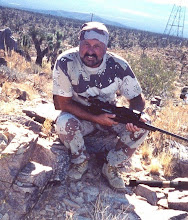
Like a lot of you, I receive monthly coyote hunting and shooting magazines and all sorts of predator hunting catalogs. Sometimes it seems as though the flood of coyote hunting product marketing has no end. Most of the monthly shooting magazine covers feature a new rifle caliber or yet another improved version of a Colt 1911 offered by one of the major manufacturers. Yup, there is always attractive bait on the hook in hopes that we consumers will consider adding yet another rifle or pistol to an already crowded gun safe. The latest marketing technique is the “combo deal” where they offer a rifle already fitted with a scope or some other accessory package. Vendors continue to make the deal attractive and easy.
Their new offering is claimed to be lighter, stronger, more accurate, and better suited to a broad spectrum of hunting. It also features this brand new caliber that will eventually prove to be a better coyote hunting round than all the rest. We’ve seen it all before, heard it all before and read about it all before, but for some strange reason we actually consider (albeit for only a few moments) buying one. The truth is that marketing works. Hence the plethora of coyote hunting and calling product and service related magazines out there competing for our subscription dollars. And…..OK, I’ll admit it…I am a sucker for most rifle ads. I have bitten the hook many times…….like a shark that hadn’t fed for a week. I just happen to be a hardware freak and in the past, I just may have been a tad too impulsive.
The truth of the matter is that the hunter that owns one rifle and shoots that one rifle all the time, typically has the higher kill ratio per shots fired. It stands to reason that if he is totally familiar with that particular rifle and the ballistics of his pet load(s), the odds for success are on his side.
As an example, consider the .243 caliber rifle. It would make a pretty darn good overall rifle for the average hunter. With a versatile barrel twist, a hunter could load and shoot a wide selection of different weight bullets to suit a variety of game. Everything from rabbits to deer sized game could be easily taken with this one caliber. It may not be your first choice for an “only” rifle but I would certainly give it serious consideration for coyote hunting.
In order to become a successful coyote hunter, you will need to be deadly accurate, efficient, familiar and safe. Accuracy comes from repetition and practice, much like a guitar player becomes proficient with his guitar. The more you shoot, the better you become. In time, you’ll develop shooting muscles that will become much steadier. You’ll be more familiar with your rifle and as a result of mastering all the combined factors mentioned above, you will be a force to be reckoned with.
Shooting one rifle and becoming thoroughly familiar with its controls, characteristics, ballistics and handling gives a hunter a definite advantage. So, if you have not gone overboard (yet) purchasing different rifles for different game, perhaps you should hold off, think about exactly what you need and keep the firearms count down to a reasonable level. Also, you'll need to check out our actual "field-proven" products from RedHunterLLC . You’ll benefit in the long run.
Monday, August 24, 2009


Saturday, August 22, 2009
Remembering My First Coyote Hunt.....sort of.
Bob, Jeff and I loaded up Bob's rig to the max and pulled out of Orange County at about 9 P.M. on Thursday night. As it turned out, I didn't need my piano, full sized gas BBQ grill, my collection of lead soldiers or the electric contour bed but Bob was nice enough to pack it all into his rig anyway. We were aware of the fact that no kills counted prior to 10 PM on Friday but we were anxious to do some scouting and give Bob some time to whip us novices into shape. After several hours of driving we began to do a few stands. On about the 4th stand, as Bob began to call for critters, a yote barked back immediately. It happened so fast and so close; I thought it was Bob's electronic caller. It took a few seconds for me to realize that we had a real live visitor. I swung the spot around and caught the yote's eyes for Jeff who was at the ready with his new General Electric 243 mini-gating gun. Jeff opened fire in a blaze of lead and fury and after a few seconds and 3000 rounds; we decided to see if we had a clean kill. We searched the area but the lifeless body of our first predator was nowhere to be found. We discussed the stand and we all decided that the damn yote was obviously wearing body armor. We knew exactly where he had been because we found a small bag of Gummy Jack Rabbits that had been hastily left behind.
Onward we went, stand after stand, call after call but had no luck for the rest of that evening. By morning we were in the area that we wanted to hunt for the remainder of our weekend. We made a simple meal of Eggs Benedict, French Pastries, Blue Mountain Coffee and a fresh fruit platter. After breakfast and a shower in the portable shower (gee, that water heater was heavy) we ironed our hunting clothes and began scouting again. After a few stands we had luck again. We had placed Bob's call box out in a field and we all took concealed positions. Out of nowhere a yote appeared and began to close in on the caller. Bob was closer than Jeff and I so it was his shot. We watched in awe as Bob skillfully centered his scope on the wary beast. The creature closed on his position and just as Bob was taking his shot, out of the bushes came this large mountain lion. It leaped for Bob and hit Bob's shooting sticks just as Bob was taking his shot. Naturally, that caused Bob's round to miss the yote. Fortunately, the discharge of Bob's rifle scared the lion away. We didn't actually see any of that part where the lion knocked his shooting sticks, causing Bob to miss his shot but Bob told us all about it. Boy, was he lucky.
We did stand after stand that evening but could not get any eyes at all. We figured that the bushy areas around the nudist colony would have been a good area to hunt but after talking to several girls at the nudist, NFL cheerleader camp, we decided that their shrill cries and laughter must have been frightening the yotes away. Finally, we gave up and played Pictionary with the Swedish Bikini Team until our late dinner of BBQ ribs, steamed artichokes, baked potatoes and Caesar salad. Dinner was good but we all thought the cheesecake was too heavy. After dinner, we hunted more and finally went to sleep for several hours. Suddenly, I awoke to the sounds of an attacking brown bear. I jumped from my contour bed only to find that it was just Jeff snoring. Whew!! That was a close one. I changed my underwear and went back to sleep.
More stands, more calls and then we found what seemed to be the perfect spot to set up a stand. A small water hole next to an open field and surrounding it were lots of bushy areas for coyotes to hide. We set the call box by the water hole and all took our positions. Bob and Jeff took the low ground and I chose a position up on the hill at the base of a rotten tree where the ants were bigger and hungrier. I was ready. I lay quietly in the piles of scat from some unknown creature, my trusty rifle sat steady on its bipod and I had a commanding view of most of the terrain below. The ants and I were ready for action (the damn ants were, that’s for sure). Bob started calling and soon the calls were returned. A bark, then a howl, just to my left. I glassed the field, expecting to see our little visitor any second. I had a prime position and knew that he was all mine. Time passed and I could hear the caller and the yote. I just didn't see him. After about 10 minutes, Bob called the stand to an end. I hiked down from my position (a mere 200 feet up the hill) and we all met at the call box. It seems that the yote was visible to everybody but me! Bob and Jeff were waiting for me to take the shot but I didn't ever see the darn thing. Meanwhile, Bob and Jeff were watching him all the time wondering what the heck I was doing up there. In retrospect, I figured that maybe I should have taken the lens caps off of my scope.

Late that evening, we had a nice lady at a small diner make us some coffee and some grub. The crab legs and lobster were great but the wine seemed a little off. Jeff sent the wine back and we settled for a newer year. Jeff met two nice men at the table next to us and invited them to join our club. I asked them where they got their nifty camo hunting tights. Jeff took a second look and then un-invited them to join our hunting club. As we prepared to leave, we noticed that Bob was asleep at the table. We picked Bob's head up, removed the mashed potatoes from his notrils and eyelashes and left.
All in all, I had a great time. I will admit that loading the same cartridge in and out of my rifle was a bit tiring but I had fun just the same. Maybe next time I'll get to take a shot at something. The bottom line for me is; the hunt entails the entire experience. It is a combination of the hunt, the verbal zingers going back and forth, and the opportunity to get to know Bob and Jeff. It was a totally positive experience (except for the snoring, late night gas attacks, and spilled rabbit urine) and I'm confident that we'll kick some coyote butts next time.
Coyote tracks and domestic dog tracks.
Do you know the difference between domestic dog and coyote tracks?
If you look closely, the tracks of the back and front foot of your average domestic dog are almost identical. Coyotes are a different story. Upon close examination, you’ll notice that front foot of a coyote is slightly larger than that of the back. The shape of the pads are also different.

The coyote’s front pad is shaped like a frown and the back pad is shaped somewhat like lips. Another way to tell the difference between coyote and dog tracks is by the pattern left in soft substrate like mud, snow, sand etc. A coyote needs to conserve energy as it never knows when its next meal is coming from and so when it runs (lopes), it will place the back foot in the print made by the front foot, creating a single line of prints which tend to be straight and usually cross open areas. Dogs tend to run with their feet side by side, making two parallel sets of tracks, which tend to meander in any direction.

There ya go then. Don’t spend half of your day tracking Lassie while Ol’ Wiley Coyote is watching and laughing from a nearby hillside. RedHunterllc.com
Friday, August 21, 2009
Frontal Shots on a Coyote

This is a front view of a coyote’s vital areas. Shooting a coyote from the front can be difficult; the neck and head are smaller targets than you think and although a properly placed bullet in either place will kill a coyote, they are difficult to place because the target is only a few inches wide (under the fur).
Since the coyote’s skull has a slope to it, there is always the risk of bouncing the bullet off the coyote’s head. I know of cases where hunters have made frontal head shots and dropped the coyote hard.
Unfortunately for one hunter, the bullet grazed the coyote’s head and simply knocked him out for a few minutes. As the hunter was dragging the seemingly dead coyote back to his hunt rig, Ol’ Wiley came back to life….in a really bad mood. That encounter was not pretty and the human hunter learned a hard lesson. In a frontal situation, make sure you place your shot right to the chest and heart area as illustrated. Check out WWW.RedHunterLLC.com for more coyote hunting tips.

Thursday, August 20, 2009
A Fun Night Hunting Coyotes at the Ranch
Last Thursday night I was hunting with a buddy on a cattle ranch. We started hunting at about 8:30 in the evening. All the rains we’ve had have really changed the landscape of the ranch because what used to be barren rolling hills is now fully grass covered and about waist high. Even the ranch roads that snake through the pastures are overgrown. If the owner of the ranch had not been with us, staying on the road would have been difficult because without local knowledge you wouldn’t know there was a road there at all. That fact alone could have caused big problems because many of the roads have steep drop-offs into canyons. The roads were also very slippery due to the wet grass but my old 1981 Jeep Cherokee hunt rig did a great job of getting us anywhere we wanted to go.
Our first stand was on top of a ridge, looking out over several grass laden rolling hills. The Jeep was on a rather uncomfortable angle as we positioned ourselves and began to call and light. My buddy was on the gun and I was doing the calling with a RedHunterLLC cow horn coyote howler, a BackStabber sound port mouth call and lighting with a RedHunterLLC lateral beam light. Within about 10-minutes or so, I picked up a set of eyes on a distant ridge. I kept the animal’s eyes in the halo of the lateral-beam light so as not to spook him. I kept calling, hoping he would come in closer so my partner could have a better shot at him. Time passed and I guess we messed around with him for at least 10-minutes or so. He was playing peek-a-boo with us and it seemed evident that he wasn’t going to come in any closer. I was concerned that he would leave so I urged the shooter to get on the eyes and take the shot.
My partner leveled his accurate 22-250 CZ with a sweet Millett 4 X 16 illuminated reticle scope but he was having difficulty picking up the eyes. I changed the light’s angle and we fussed and fussed but under the dim red light, he just couldn’t find the coyote’s eyes with his scope. I guess he got tired of me verbally harassing him and handed me his rifle and said, “Here, you shoot the damn thing.” We swapped positions and I took his rifle. He grabbed the light, illuminated the animal’s eyes and as he said, “Can you…..” BOOM, I fired and I heard that unmistakable “thwap” of a bullet hitting flesh. “I think I got him.” I said. My buddy looked at me and said, “I didn’t hear anything.” The ranch owner up in the passenger seat said, “I heard it for sure too.” So, the hunt was on and the relentless teasing began.
We set my powerful green laser up to mark the path to the kill and the ranch owner and I began the task of trying to get to the animal. Down a hill, through a barbed wire fence, up a hill, down a hill and then we encountered faults from a recent landslide. That was no fun because the night was dark, the grass was nearly waist high and trying to navigate to the area where I hoped to find my animal was getting a bit dangerous. It would have been easy to slip on the wet grass and fall into one of the many concealed ravines. We were two-thirds of the way there but it just became too hairy of a trip. It wasn’t worth a broken leg, or worse. We ended up working our way back to my old Jeep hunt rig.
Naturally, my hunting partner teased me (it’s part of the fun) about missing the coyote. We did several more stands and picked up four more sets of eyes. They played with us and wouldn’t present us with an opportunity for a shot. The ranch owner finally got off a shot on a distant yote but we couldn’t get to that location either. My partner never did get another opportunity for a shot. We called it an evening at about 11 PM because the rancher gets up a 4:30 in the morning. It was a fun night though and what could be better than hunting coyotes with a couple of buddies.
Today was Monday and since I had left my cell phone in my car through the weekend, I did not get ranch owner’s voice message until today. On Friday, the ranch owner went out there in the daylight to where he knew the coyote might be. There it was, DOA. Weeeeeeee Haaaaaa!! My bullet had entered the coyote’s skull smack between his eyes. It passed through his head and killed the coyote before he heard the shot. The Ranch owner also sent me two photos of the kill via e-mail. The ranch owner’s friend laser-ranged the shot and it was a 275-yard trip from the Jeep’s location to the kill.
My thanks to the ranch owner for letting us hunt his ranch and thanks to my partner for letting me take the shot with his dialed in 22-250. The combination of precise 22-250 loads and my buddy’s CZ rifle topped with a clear, illuminated reticle Millet scope put the round right where I pointed it. I was so happy to finally know for sure that the coyote was mine.

Predator hunting and night shooting sharpens your shooting skills like nothing else. My partner will surely nail one next time. In the meantime, I get to relentlessly taunt him.
Coyote hunting sure beats the hell out of a sport like golf. I am so hooked on this action packed sport, it’s pathetic. I can’t wait to get out again and hunt the hunters.
Wednesday, August 19, 2009
Make your own open-reed coyote/predator call
Imagine being able to actually talk to predatory animals? You can by making your own predator call and coyote howler. Coyotes, bobcats, fox, mountain lion and other predators all respond to the sound of an injured animal. Believe it or not, all of the above respond and will come to the call of an injured jackrabbit. If they think there is a free meal to be had, the predators will come in for it. You can purchase what is called an open-reed predator call from call companies like RedHunterLLC.com or you can attempt to make one yourself. The instructions below will allow you to make a nice, small open reed call or a coyote howler, using a cow horn that can be purchased at craft stores.
Making your own mouth blown predator calls and howlers is a fun and interesting project. I found that once I started making my own calls, I became really interested in the tuning aspects of the whole project. There are no rules and you can do whatever you like to perfect your own distinctive calls.
Going to the Sound Files page of RedHunterLLC.com will give you examples of what your calling should sound like. Once you finish making your call, practice until you can mimic the sounds on that Sound Files page and you are ready to call in some predators.
WARNING: Keep in mind that you are calling in predatory animals. These animals can be dangerous to you and people around you. Make sure you watch your back and don’t go calling alone.
You will need to assemble the following raw materials:
- A section of 5/8” Delrin rod with a hollow center or you can also use PVC pipe a hardwood or whatever is handy
- Rubber bands to hold the reed in place (castration bands from a feed store work best)
- Reed material. You can buy 8” X 10” thin Mylar sheets at craft shops. It is used for pattern making.

The Delrin rod is shown with a hole through the center. This core becomes the mouthpiece or sound board of your call.
Step 1

The first step is to do the preliminary layout for the construction of your mouthpiece. I find it easier to use masking tape and I mask out the material to mark my basic first cuts. Once marked with the masking tape, the next step is the band saw. I have also used a hacksaw, a Mikita cordless circular saw and a Dremel tool cutter to perform the cuts. A band saw works best however.
Note that the cut bisects the upper third of the hole in the center of the Delrin rod.
Step 2

The photo to the left shows the Delrin rod after the cuts have been made. When making the longitudinal cut, let the blade cut back past the tape a tad. This will provide a small notch for the rear of the reed to rest in.
Step 3

I perform the shaping with a belt sander, using a 220-grit belt. After doing the rough shaping (shown at left) I fair the project out by hand using 220 & 320 grit paper. Delrin can also be wet sanded with “wet & dry” sandpaper for a super smooth finish.
In the photo to the left you can easily see the effect of the extended longitudinal cut for the reed end.
Step 4
Here is where it starts t o get a bit tricky. You may say this is the “tuning” stage. Now it is a matter of reed material, reed length, reed thickness, reed shape and reed width. Another factor is the “shape” you made the mouthpiece end of the Delrin rod. At this stage, there are many variations and experimentation is the name of the game. Adjust the factors mentioned above to create the sound you are looking for. With a little luck and patience, you will have no problems getting the desired tone and pitch. Trial and error is the name of the game here. Hint: Play around more with your reed material prior to making any shaping changes on your mouthpiece. It’s a lot easier to change the reed than to cut out and shape another mouthpiece.
 o get a bit tricky. You may say this is the “tuning” stage. Now it is a matter of reed material, reed length, reed thickness, reed shape and reed width. Another factor is the “shape” you made the mouthpiece end of the Delrin rod. At this stage, there are many variations and experimentation is the name of the game. Adjust the factors mentioned above to create the sound you are looking for. With a little luck and patience, you will have no problems getting the desired tone and pitch. Trial and error is the name of the game here. Hint: Play around more with your reed material prior to making any shaping changes on your mouthpiece. It’s a lot easier to change the reed than to cut out and shape another mouthpiece.
Step 5


Your basic mouthpiece is pictured to the left and has the reed mounted and banded with a “castration band”. To change the tone, adjust the reed by cutting shorter, thinner and moving the band up or down. Play with different reed materials and perform your own experiments until the desired tone and pitch range is achieved.
You have now completed the heart of your open reed predator call. You can mount it in a holder tube or go on to Step 6 and make a coyote howler.

This photo shows another style of mouthpiece mounted in a tube to make an open reed predator call. I made the tube from a solid Delrin rod and then machined the grooves in it on a lathe.
You don’t need any fancy tools or a lathe. You can make your tube from PVC or any other material that is handy. In the example above, the tube is about 3.5” long.
Some call makers love to use wood to make calls and some use metal, plastic or whatever suits their fancy. Keep your first one simple and get out and call some critters.
Step 6

The photo on the left shows the fitting of the mouthpiece to construct a cow horn coyote howler. The end of the horn was cut off with a band saw (don’t cut off too much!). Once you cut off the end of the horn there won’t be a visible hole through the horn. You’ll have to drill a hole using a ¼” drill bit through the center of the end, into the open part inside the horn.
After making your hole within an eighth of an inch of the horn’s sidewall, use a file or a rotary rasp to rough fit the mouthpiece. Do the final fitting with 100-grit sandpaper until the mouthpiece can be forced gently into place. Remove the mouthpiece and set aside. It’s time to sand and polish a bit before finally gluing in the mouthpiece.
Step 7

Now it is time to shape and wet sand the cow horn. Begin by sanding a slight bevel on the cut you made to the horn where the mouthpiece is to be inserted. You can do the rough bevel with the belt sander and the finish work with 100 and 220-grit sandpaper. After that is done, it’s time to take some 320-grit “wet & dry” sandpaper and wet sand the entire cow horn (I am assuming you purchased an unfinished horn). After wet sanding smooth, clean the inside of the horn and dry with a rag.
The final buffing will be a lot easier if you have a cloth buffing wheel on a grinder. I use 3M fine finishing compound to do the initial buffing and finish off with a glazing compound. The horn shines up very nicely and looks great when finished. See photo below.
Your finished product can be a howler or a mouth call. Your finished coyote or predator caller is only limited by your imagination. Have fun with this project and make several calls that have varied tones for different animals.

Whatever you do, you will have the satisfaction of knowing that you called in that song dog or bobcat with a call that you made with your own two hands. For more info visit RedHunterLLC.
Best regards……Red@RedHunterLLC.com
Grand Opening
Although I have been a writer for quite a while, I have never had a blog. At 62-years old a lot of this new fangled stuff kinda throws me at first. All the buzz words, passwords and other related stuff is not always something I have the time or energy to learn. But, there is a lot of information I would like to share and this seems to be the best medium for doing so.
My blog won't be all about me, it will be about the things I make, use and have learned about predator hunting. Hunting the hunters is always a humbling experience and no matter how much time I spend in the field scouting, tracking, stalking and calling, the animals still manage to teach me something new every time I venture out.
I will attempt to pass on information about predator hunting firearms, building coyote calls, how to call coyotes and other predators and the methods that have worked successfully for me and other coyote hunters.
 My most valuable piece of equipment is my dedicated hunt rig. When I go deep into California and Nevada's Mojave Desert, my 1981 full sized Jeep Cherokee Chief if my lifeline. Because I am often way out and away from civilization or any type of support, I make dang sure that the old Jeep is in top shape. I hesitate to tell ya'll just how much money I have dumped into that old Jeep but it has taken me where no man has gone before and brought me back home, time and again.
Since I am frequently testing calls and products for RedHunter LLC, I need a vehicle that will negotiate small trails, deal with boulders and sometimes make its own road. "Jezebelle" does just that and has been a good investment. I will feature her in another blog and show you her guts and specialized predator hunting features.
So, hang in there with me, if you dare, and I will attempt to master the ins and outs of the blog thing. My posts may be a bit rough at first but I'll figure it out eventually.
Subscribe to:
Posts (Atom)